

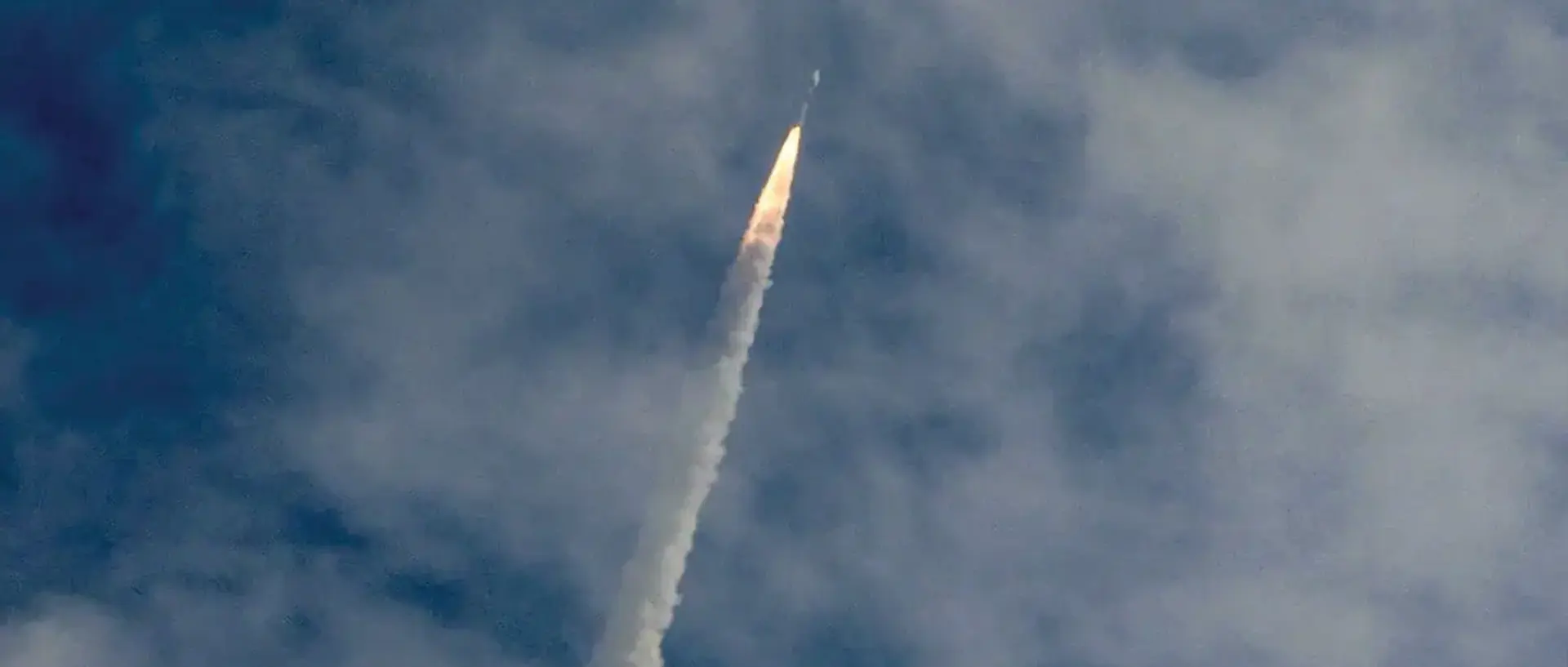
India’s first space mission of 2026 faced a major setback today, Monday, January 12, 2026, as the PSLV-C62 mission encountered a critical technical failure shortly after launch. While the rocket successfully lifted off from the Satish Dhawan Space Centre in Sriharikota, a performance anomaly in the third stage prevented the satellites from reaching their intended orbits.
The mission was carrying the primary payload EOS-N1 (Anvesha) along with 15 co-passenger satellites.
1. Mission Timeline and Anomaly
The launch appeared to be a success during the initial phases before technical issues emerged mid-flight.
- Lift-off: The PSLV-DL variant thundered off the First Launch Pad at 10:18 AM IST following a 22.5-hour countdown.
- Initial Success: The first and second stages of the rocket performed nominally, and the heat shield separation was completed as planned.
- The Glitch: Silence gripped Mission Control during the third-stage (PS3) operation. ISRO Chairman V. Narayanan later confirmed that the vehicle experienced a disturbance in roll rates and a subsequent deviation from its flight path.
- Current Status: Preliminary data suggests a drop in chamber pressure in the third stage, mirroring a similar issue that affected the PSLV-C61 mission in 2025. As a result, the 16 satellites are feared lost.
2. Primary Payload: The “Anvesha” Spy Satellite
The primary goal of the mission was to deploy EOS-N1, also known as Anvesha, a sophisticated hyperspectral Earth observation satellite developed for the DRDO.
- Strategic Surveillance: Anvesha was designed to provide cutting-edge imaging for national security and border monitoring. Its hyperspectral sensors allow it to “see” through camouflage by analyzing materials based on their light reflection.
- Civilian Uses: Beyond defense, the satellite was intended to support precision agriculture, disaster management, and urban planning.
3. Co-Passenger Payloads
Managed by NewSpace India Limited (NSIL), this was the ninth dedicated commercial mission for the PSLV. The rocket carried a diverse group of 15 secondary satellites:
- International Contribution: Payloads from Spain, Brazil, and Nepal, including a re-entry capsule demonstrator (KID) from a Spanish startup.
- Indian Startups: Significant participation from the domestic private sector, including Dhruva Space, which had five satellites on board.
- Student Innovation: Payloads like Munal (built by high school students from Nepal) and CGUSAT (C.V. Raman Global University) were also part of the mission.
4. Technical Recovery and Future Outlook
This marks the second consecutive third-stage issue for the PSLV, a rare occurrence for a vehicle often called the “Workhorse of ISRO.”
- Failure Analysis: ISRO has constituted a Failure Analysis Committee (FAC) to conduct a deep-dive into the telemetry data. The committee will specifically examine the solid-fuel motor and nozzle integrity of the third stage.
- Cadence Impact: The setback may affect ISRO’s ambitious 2026 launch calendar, which includes several high-profile missions and the expansion of the NavIC navigation constellation.
- Chairman’s Resolve: Chairman Narayanan vowed a rapid recovery, stating that while setbacks are part of space exploration, the agency is committed to identifying the “ghost in the machine” and returning stronger.
Mission Summary at a Glance
| Detail | Information |
| Mission Name | PSLV-C62 / EOS-N1 |
| Launch Date | January 12, 2026 |
| Rocket Variant | PSLV-DL (2 Strap-on Motors) |
| Total Payloads | 16 (1 Primary + 15 Co-passengers) |
| Mission Outcome | Unsuccessful (Orbit Insertion Failure) |
Discover more empowering stories and insightful content like this on GRISU TIMES, your go-to destination for inspiration and knowledge.
Follow GRISU TIMES on Instagram: https://www.instagram.com/grisutimes/